Learning to release
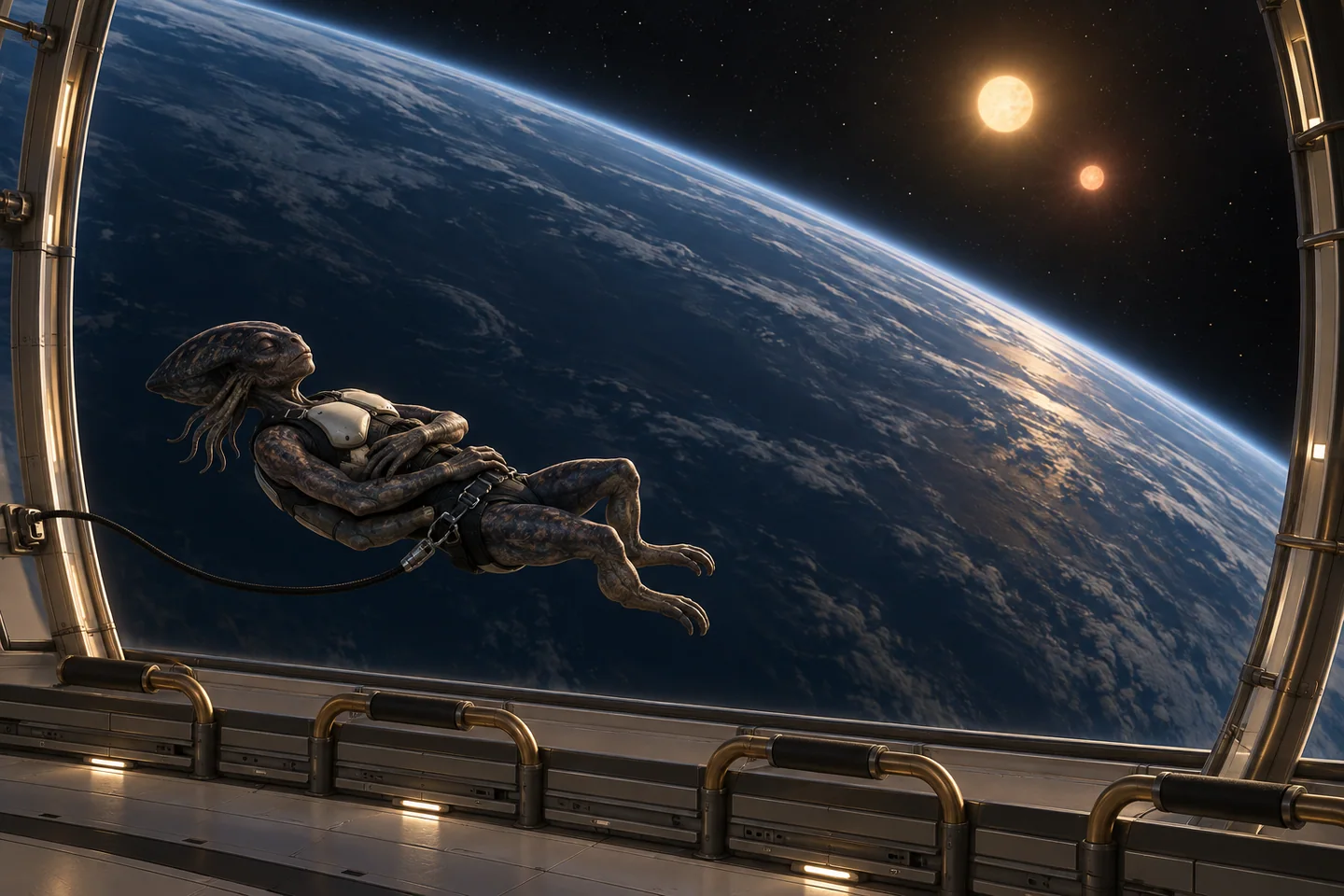
A tethered warrior practices controlled release in a pressurized orbital habitat, floating before a vast planetary limb. Fictional warrior portrait: He loosens the last unnecessary contraction in his legs and notices how little effort the next moment requires. The floor remains nearby, but he is no longer standing on it. A tether curves between his harness and the structure. Its quiet presence allows the exercise to remain a practice in attention rather than a test of how much risk he is willing to ignore. His first attempts in the chamber were full of corrections. A small rotation prompted a large response, followed by another attempt to undo the first. Habits learned with weight underfoot had arrived before understanding. The patient work has been to recognize those habits without treating them as failures of character, then discover which movements the new setting actually calls for. He folds his arms and makes one change at a time. The enclosure, its attendants and its working systems make that patience possible. He has inspected his connection and agreed on the limits of the exercise. Releasing muscular effort does not release responsibility. It asks him to distinguish the supports he can trust from the tensions he is maintaining only because they feel familiar. Outside, the planetary curve displaces his usual sense of up and down. He can orient his attention toward it without declaring that it is a floor. The view allows several relationships to coexist: his body to the tether, the chamber to its surroundings, the visible world to the stars beyond. No single familiar direction is enough to explain them all. When he reaches for a handhold, he does so gently. He wants to preserve what the exercise has taught him through the transition back to ordinary duties. Some tasks need more effort; others need the removal of effort that interferes. A warrior who can tell the difference has another kind of freedom, and a less exhausting way to inhabit unfamiliar space.
The imagined scene
The host system is real. All alien organisms, robots, societies and social histories are fictional. Moons, rings, terrain and weather are artistic assumptions unless specifically supported by a cited source. These images are not calibrated simulations of the sky.
The scientific anchor
TOI-1338 b is a catalogued exoplanet orbiting TOI-1338 A. The saved NASA composite snapshot lists an orbital period of 95.4001 days; uncertainties, limits and source provenance are preserved in the companion measurement table. Its catalog orbit is circumbinary. Viewpoint: enclosed orbital habitat in free fall. All warriors, beliefs, cultures and constructed environments are fictional.
Wang & Liu 2024 · NASA Exoplanet Archive system overview · Kostov et al. 2020 · ExoFOP · Gaia DR2
Available measurements
Host: TOI-1338 A · 2 catalog star(s) · Giant-size planet
NASA composite catalog values may combine different papers. Errors and upper/lower limits are retained. “Calculated Value” means derived or estimated. Msini is a minimum mass. Missing values are unknown. A multiple-star system’s single stellar row does not describe every component. Equilibrium temperature is not a measured surface temperature.
| Quantity | Value & uncertainty | Unit | Paper / source |
|---|---|---|---|
| Planet radius | 7.661 [+0.053 / -0.053] | Earth radii | Wang & Liu 2024 |
| Planet mass | 11.3 [+2.1 / -2.1] | Earth masses | Wang & Liu 2024 |
| Bulk density | 0.56 [+0.34 / -0.33] | g/cm³ | Kostov et al. 2020 |
| Orbital period | 95.4 [+0.0062 / -0.0056] | days | Wang & Liu 2024 |
| Orbital semimajor axis | 0.4607 [+0.0084 / -0.0088] | AU | Kostov et al. 2020 |
| Orbital eccentricity | 0.0331 [+0.0022 / -0.0021] | Wang & Liu 2024 | |
| Orbital inclination | 90.494 [+0.013 / -0.014] | degrees | Wang & Liu 2024 |
| Irradiation | 0.9938 | Earth flux | ExoFOP |
| Equilibrium temperature | 254.65 | K; not surface temperature | ExoFOP |
| Catalog stellar effective temperature | 5,723.2 [+57 / -57] | K | ExoFOP |
| Catalog stellar radius | 1.313 [+0.0038 / -0.0038] | Solar radii | Wang & Liu 2024 |
| Catalog stellar mass | 1.0936 [+0.0072 / -0.0072] | Solar masses | Wang & Liu 2024 |
| Catalog stellar luminosity | 0.32898 [+0.00639 / -0.00648] | log10 Solar luminosity | Gaia DR2 |
| Catalog stellar age | 4.4 [+0.2 / -0.2] | Gyr | Kostov et al. 2020 |
| Catalog stellar metallicity | 0.01 [+0.05 / -0.05] | dex | Kostov et al. 2020 |
| System distance | 399.02 [+3.162 / -3.113] | pc | TICv8 |
What about life?
Likely a deep gaseous envelope, without a solid exterior surface. Atmospheric or moon life is speculative; this is not proof that all life is impossible. No confirmed life; no planet-specific biosignature literature review in this release.
Papers and references
Wang & Liu 2024 · NASA Exoplanet Archive system overview · Kostov et al. 2020 · ExoFOP · Gaia DR2 · TICv8