A measure of ground
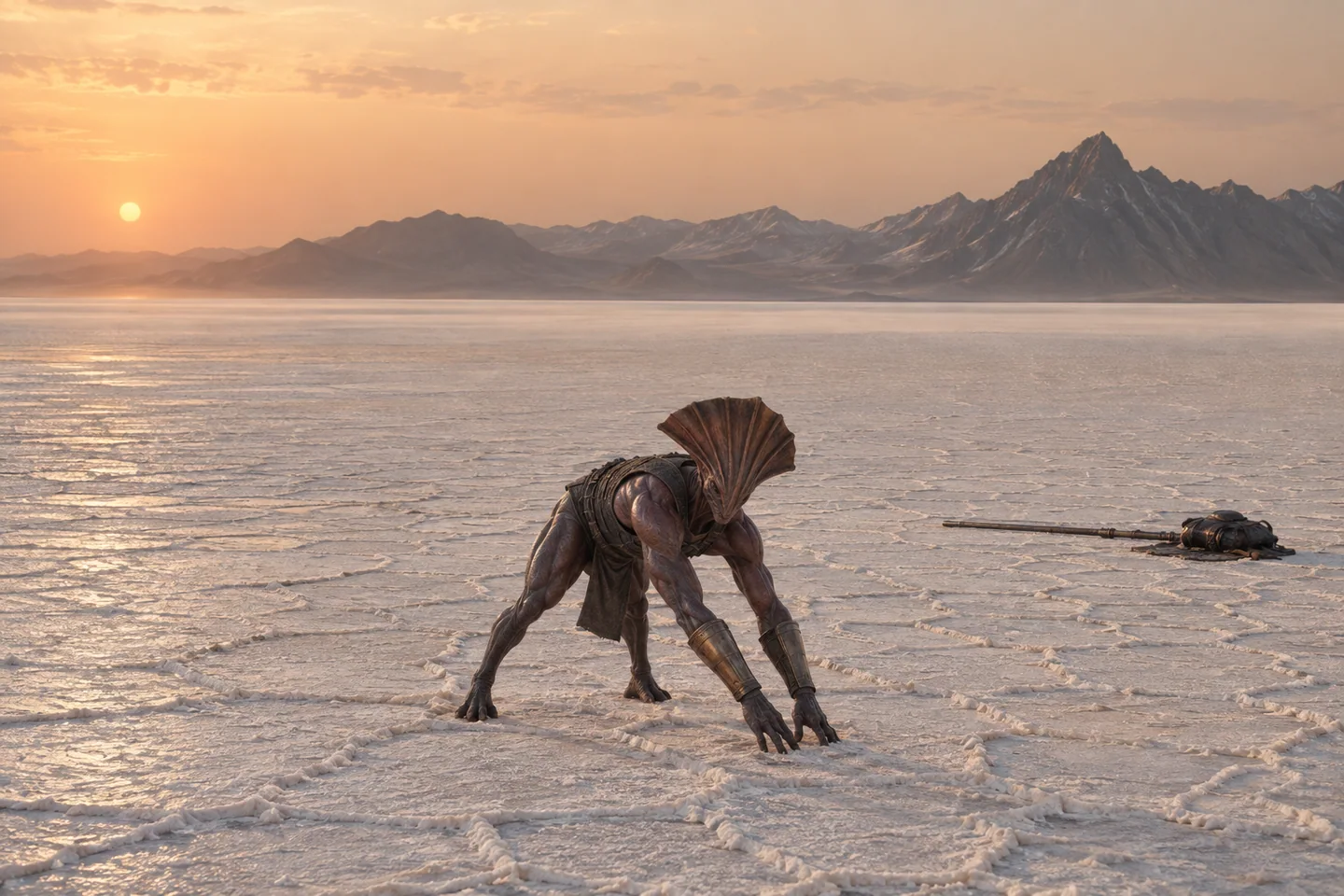
A fan-crested warrior stretches close to a pale mineral plain, setting personal effort against an almost uninterrupted horizon. Fictional warrior portrait: She spreads her hands against the mineral crust and waits for her weight to settle. The plain appears almost empty, but contact reveals its detail: a raised edge beneath one fingertip, a firmer patch under a foot, a small unevenness that changes the angle of her shoulders. The horizon draws her outward while the ground asks her to notice exactly where she is. After a demanding practice, she has a habit of moving immediately to the next task. This stretch interrupts that momentum. She gives each supporting limb time to accept its share of the load and allows her breathing to become unhurried. The body is still working, but the work has changed from producing force to understanding how that force has passed through her. Her protective guards are familiar enough to disappear from attention until she feels their pressure against her skin. She adjusts one and remembers the craft that shaped it. Training relies on such ordinary exchanges between living bodies and material things. A poorly fitted piece can narrow a movement; a careful repair can return a freedom she had begun to think was lost. Beyond her, the pale basin stretches farther than she can cross in one session. She does not need to measure its whole extent to feel part of it. Her contact with the world is local and exact, made through weight, temperature and balance. The vast view enlarges that relationship without replacing the small sensations through which she knows it. She rises gradually and retrieves the equipment she set aside. Grounding has given her a way to return from ambition to circumstance. Before accepting another burden, she can ask where she stands and what is already being carried. The answer may change, but the willingness to feel for it can accompany her into every unfamiliar place.
The imagined scene
The host system is real. All alien organisms, robots, societies and social histories are fictional. Moons, rings, terrain and weather are artistic assumptions unless specifically supported by a cited source. These images are not calibrated simulations of the sky.
The scientific anchor
LHS 1140 b is a catalogued exoplanet orbiting LHS 1140. The saved NASA composite snapshot lists an orbital period of 24.73723 days; uncertainties, limits and source provenance are preserved in the companion measurement table. Viewpoint: speculative mineral plain. All warriors, beliefs, cultures and constructed environments are fictional.
Cadieux et al. 2024 · NASA Exoplanet Archive system overview · Dittmann et al. 2017 · TICv8
Available measurements
Host: LHS 1140 · 1 catalog star(s) · Super-Earth / transition
NASA composite catalog values may combine different papers. Errors and upper/lower limits are retained. “Calculated Value” means derived or estimated. Msini is a minimum mass. Missing values are unknown. A multiple-star system’s single stellar row does not describe every component. Equilibrium temperature is not a measured surface temperature.
| Quantity | Value & uncertainty | Unit | Paper / source |
|---|---|---|---|
| Planet radius | 1.73 [+0.025 / -0.025] | Earth radii | Cadieux et al. 2024 |
| Planet mass | 5.6 [+0.19 / -0.19] | Earth masses | Cadieux et al. 2024 |
| Bulk density | 5.9 [+0.3 / -0.3] | g/cm³ | Cadieux et al. 2024 |
| Orbital period | 24.737 [+2e-05 / -2e-05] | days | Cadieux et al. 2024 |
| Orbital semimajor axis | 0.0946 [+0.0017 / -0.0017] | AU | Cadieux et al. 2024 |
| Orbital eccentricity | ≤ 0.043 (upper limit) | Cadieux et al. 2024 | |
| Orbital inclination | 89.86 [+0.04 / -0.04] | degrees | Cadieux et al. 2024 |
| Irradiation | 0.43 [+0.03 / -0.03] | Earth flux | Cadieux et al. 2024 |
| Equilibrium temperature | 226 [+4 / -4] | K; not surface temperature | Cadieux et al. 2024 |
| Catalog stellar effective temperature | 3,096 [+48 / -48] | K | Cadieux et al. 2024 |
| Catalog stellar radius | 0.2159 [+0.003 / -0.003] | Solar radii | Cadieux et al. 2024 |
| Catalog stellar mass | 0.1844 [+0.0045 / -0.0045] | Solar masses | Cadieux et al. 2024 |
| Catalog stellar luminosity | -2.4202 [+0.033 / -0.03572] | log10 Solar luminosity | Cadieux et al. 2024 |
| Catalog stellar age | ≥ 5 (lower limit) | Gyr | Cadieux et al. 2024 |
| Catalog stellar metallicity | -0.15 [+0.09 / -0.09] | dex | Cadieux et al. 2024 |
| System distance | 14.986 [+0.0153 / -0.0152] | pc | TICv8 |
What about life?
Passes a deliberately broad 0.25–1.75 Earth-flux triage window. This is not a calculated habitable zone or evidence of water or life. Atmosphere, surface pressure, water inventory, stellar activity and orbital history remain unassessed. No confirmed life; no planet-specific biosignature literature review in this release.
Papers and references
Cadieux et al. 2024 · NASA Exoplanet Archive system overview · Dittmann et al. 2017 · TICv8