The last lesson
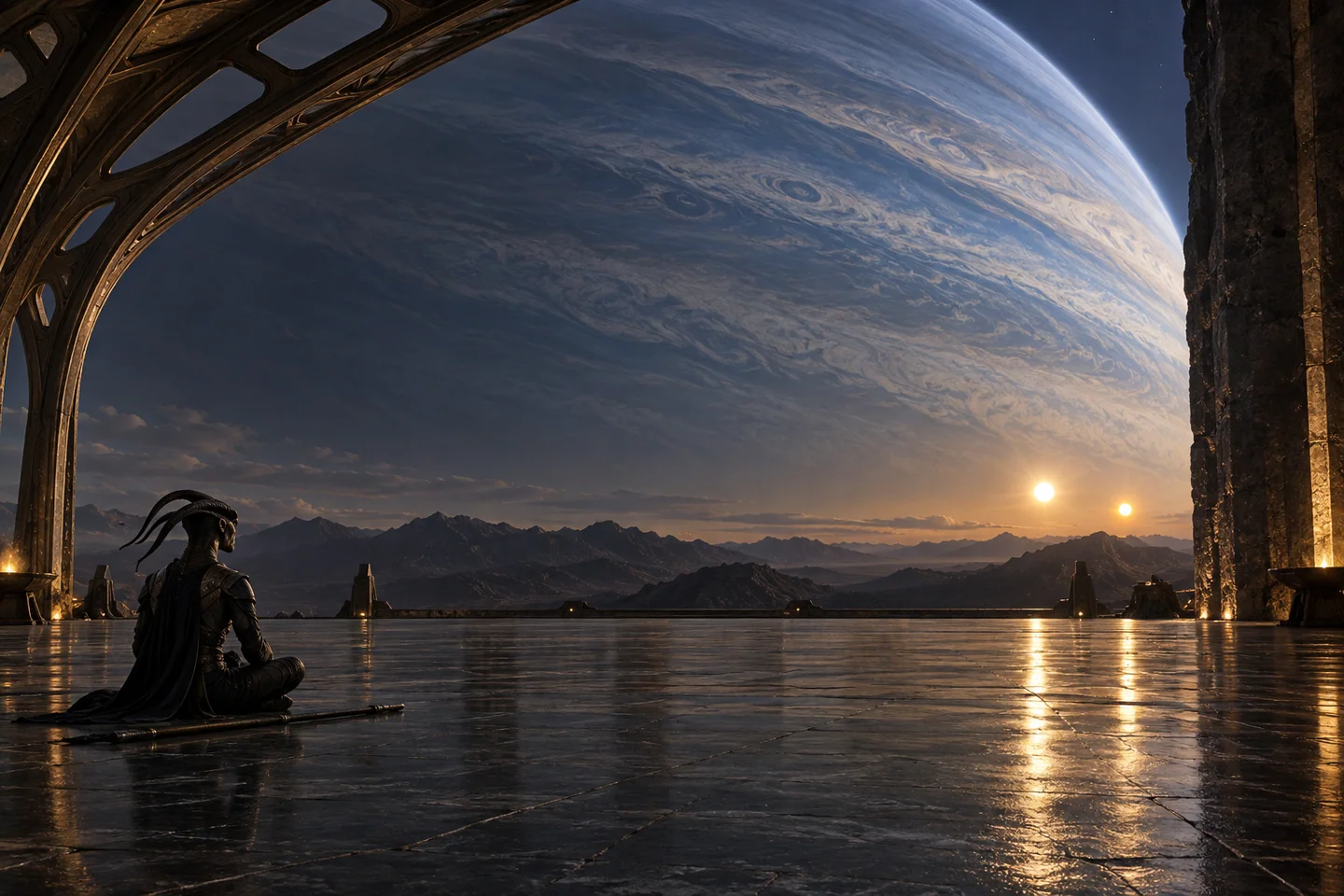
A lone warrior meditates in a vast empty hall as the parent planet fills the view. The hall, atmosphere, moon and living culture are all fictional. Fictional warrior portrait: She sits in the great hall after practice, with nothing left to demonstrate. The staff, the floor and the distant world remain distinct, but her attention moves among them without strain. Discipline has become a way of inhabiting the moment, carried as naturally as the armor on her shoulders. The empty floor preserves small traces of the day: a faint scuff where a student lost balance, a mark left by the end of a staff, a place where someone stopped to listen. She remembers these details more readily than the most accomplished performance. They show learning while it is still imperfect, before repetition smooths away the visible effort and makes a difficult action look inevitable. When she was younger, she imagined mastery as an arrival beyond doubt. Years of practice have given her better questions. Can she recognize a habit before it narrows her judgment? Can she revise an instruction that no longer helps a student? Can she allow another warrior to surpass her without turning their achievement into an account of her own loss? These questions make the hall feel new even after countless returns. Beyond it, the immense planetary face provides a distance against which her achievements and regrets both become smaller. She does not discard them. They remain part of the life for which she is answerable. She simply allows other scales to exist alongside her own: the immediate need of another person, the endurance of a community, the long processes through which a world takes shape. Soon she will stand, gather the staff and extinguish the hall’s remaining lights. The ordinary sequence is part of the lesson. Practice reaches its fullest expression when care survives the end of ceremony, when strength can carry a burden without announcing itself, and when attention remains generous after the formal exercise is complete. The next beginning may be no more remarkable than opening the door for someone who has come to learn. The final lesson has no finish. Strength must be renewed; judgment must be examined; stillness must be chosen again. Beneath two suns, this imagined warrior understands her place in the cosmos as a responsibility to live carefully within it, and to leave room for lives beyond her own.
The imagined scene
The host system is real. All alien organisms, robots, societies and social histories are fictional. Moons, rings, terrain and weather are artistic assumptions unless specifically supported by a cited source. These images are not calibrated simulations of the sky.
The scientific anchor
Kepler-35 b is a real catalogued exoplanet orbiting Kepler-35. The local NASA composite snapshot lists an orbital period of 131.458 days; the companion measurement table preserves reported uncertainties, limits and source provenance. This is a circumbinary planetary system. The viewpoint is: imagined atmospheric moon. All warriors, cultures, training practices and constructed environments are fictional. The depicted ground belongs to an invented moon, not to an exposed solid surface of the giant planet. No exomoon detection is claimed.
Welsh et al. 2012 · NASA Exoplanet Archive system overview · TICv8
Available measurements
Host: Kepler-35 · 2 catalog star(s) · Giant-size planet
NASA composite catalog values may combine different papers. Errors and upper/lower limits are retained. “Calculated Value” means derived or estimated. Msini is a minimum mass. Missing values are unknown. A multiple-star system’s single stellar row does not describe every component. Equilibrium temperature is not a measured surface temperature.
| Quantity | Value & uncertainty | Unit | Paper / source |
|---|---|---|---|
| Planet radius | 8.16 [+0.157 / -0.157] | Earth radii | Welsh et al. 2012 |
| Planet mass | 40.363 [+6.356 / -6.356] | Earth masses | Welsh et al. 2012 |
| Bulk density | 0.41 [+0.07 / -0.069] | g/cm³ | Welsh et al. 2012 |
| Orbital period | 131.46 [+0.077 / -0.105] | days | Welsh et al. 2012 |
| Orbital semimajor axis | 0.60347 [+0.00101 / -0.00103] | AU | Welsh et al. 2012 |
| Orbital eccentricity | 0.042 [+0.007 / -0.004] | Welsh et al. 2012 | |
| Orbital inclination | 90.76 [+0.12 / -0.09] | degrees | Welsh et al. 2012 |
| Irradiation | 2.5804 [+0.2764 / -0.2764] | Earth flux | Calculated Value |
| Equilibrium temperature | 352.89 [+9.45 / -9.45] | K; not surface temperature | Calculated Value |
| Catalog stellar effective temperature | 5,606 [+150 / -150] | K | Welsh et al. 2012 |
| Catalog stellar radius | 1.0284 [+0.002 / -0.0019] | Solar radii | Welsh et al. 2012 |
| Catalog stellar mass | 0.8877 [+0.0051 / -0.0053] | Solar masses | Welsh et al. 2012 |
| Catalog stellar luminosity | -0.027 [+0.044 / -0.049] | log10 Solar luminosity | Welsh et al. 2012 |
| Catalog stellar age | Unknown | Gyr | Source not supplied |
| Catalog stellar metallicity | -0.34 [+0.2 / -0.2] | dex | Welsh et al. 2012 |
| System distance | 1,819.2 [+120.96 / -107.03] | pc | TICv8 |
What about life?
Likely a deep gaseous envelope, without a solid exterior surface. Atmospheric or moon life is speculative; this is not proof that all life is impossible. No confirmed life; no planet-specific biosignature literature review in this release.
Papers and references
Welsh et al. 2012 · NASA Exoplanet Archive system overview · TICv8