Orbits of discipline
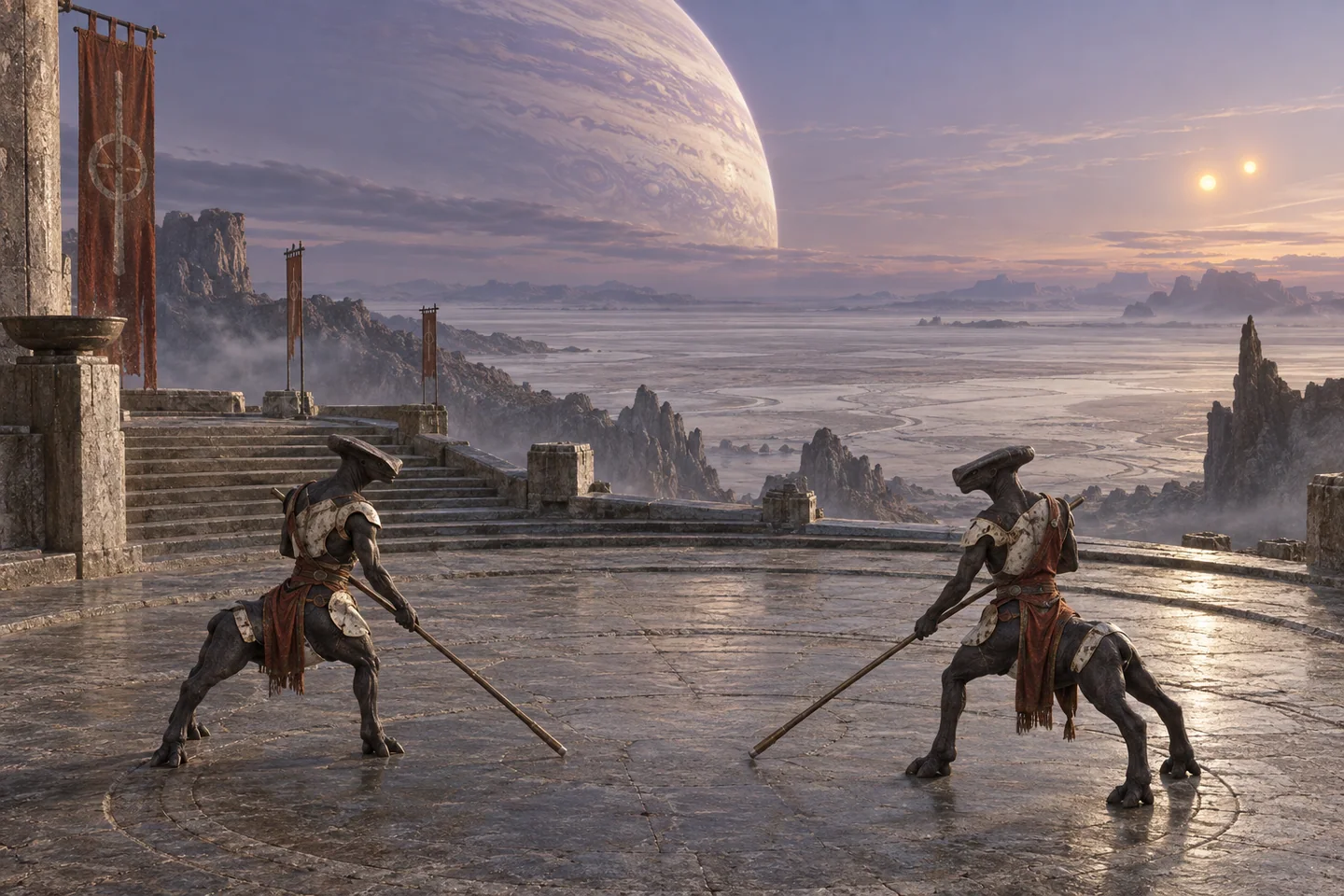
Two four-legged warriors practice mirrored staff forms on a courtyard overlooking an invented moon. The giant parent planet and paired suns make individual movements seem small. Fictional warrior portrait: They lower their staffs together, watching the space between them as carefully as their own hands. She adjusts her footing; he waits for her balance to settle. Neither wins this exercise. They succeed when both can finish the movement with more awareness than they brought to it. They begin with a greeting and a clear agreement about the pace. Each has trained long enough to know that familiarity can encourage assumptions. Before the first movement, she asks whether an old joint injury is troubling him; he answers without embarrassment. Their practice improves when useful information can pass between them freely. The courtyard is a place where neither has to protect an appearance of perfection. In the middle of the form, one staff arrives early. Both stop. They trace the mistake backward through their positions and begin again from an easier passage. No explanation is treated as an accusation. The shared aim is to understand what happened while the cost is small, so that attention remains available when a future task demands more of them. Each learns something different from the same exchange. She is quick to recognize an opening but sometimes moves before her footing is settled. He holds his position well but can hesitate when the pattern changes. They offer one another a kind of knowledge that solitary practice cannot provide: the experience of being met by another will, with its own timing, strengths and uncertainties. The great world overhead places their courtyard within a larger scene, but it is the small distance between them that asks for care. They cannot protect every life beneath every sky. They can make this encounter responsible. When the staffs are lowered at the end, trust has acquired a physical history—moments in which each could rely on the other to notice, to pause, and to begin again. Above the courtyard, the paired suns suggest a useful metaphor for their practice: separate presences sharing a larger order. The comparison is poetic, not a law of combat. Their strength grows through trust, and their discipline lies in preserving another person’s safety while testing the limits of their own control.
The imagined scene
The host system is real. All alien organisms, robots, societies and social histories are fictional. Moons, rings, terrain and weather are artistic assumptions unless specifically supported by a cited source. These images are not calibrated simulations of the sky.
The scientific anchor
Kepler-1647 b is a real catalogued exoplanet orbiting Kepler-1647. The local NASA composite snapshot lists an orbital period of 1107.5923 days; the companion measurement table preserves reported uncertainties, limits and source provenance. This is a circumbinary planetary system. The viewpoint is: imagined atmospheric moon. All warriors, cultures, training practices and constructed environments are fictional. The depicted ground belongs to an invented moon, not to an exposed solid surface of the giant planet. No exomoon detection is claimed.
Kostov et al. 2016 · NASA Exoplanet Archive system overview · Gaia DR2 · TICv8
Available measurements
Host: Kepler-1647 · 2 catalog star(s) · Giant-size planet
NASA composite catalog values may combine different papers. Errors and upper/lower limits are retained. “Calculated Value” means derived or estimated. Msini is a minimum mass. Missing values are unknown. A multiple-star system’s single stellar row does not describe every component. Equilibrium temperature is not a measured surface temperature.
| Quantity | Value & uncertainty | Unit | Paper / source |
|---|---|---|---|
| Planet radius | 11.874 [+0.1377 / -0.1377] | Earth radii | Kostov et al. 2016 |
| Planet mass | 483 [+206 / -206] | Earth masses | Kostov et al. 2016 |
| Bulk density | 1.59 | g/cm³ | Calculated Value |
| Orbital period | 1,107.6 [+0.0227 / -0.0227] | days | Kostov et al. 2016 |
| Orbital semimajor axis | 2.7205 [+0.007 / -0.007] | AU | Kostov et al. 2016 |
| Orbital eccentricity | 0.0581 [+0.0689 / -0.0689] | Kostov et al. 2016 | |
| Orbital inclination | 90.097 [+0.0035 / -0.0035] | degrees | Kostov et al. 2016 |
| Irradiation | 0.5956 [+0.0339 / -0.0339] | Earth flux | Calculated Value |
| Equilibrium temperature | 242.92 [+3.94 / -3.94] | K; not surface temperature | Calculated Value |
| Catalog stellar effective temperature | 6,210 [+100 / -100] | K | Kostov et al. 2016 |
| Catalog stellar radius | 1.7903 [+0.0055 / -0.0055] | Solar radii | Kostov et al. 2016 |
| Catalog stellar mass | 1.2207 [+0.0112 / -0.0112] | Solar masses | Kostov et al. 2016 |
| Catalog stellar luminosity | 0.64425 [+0.0239 / -0.02529] | log10 Solar luminosity | Gaia DR2 |
| Catalog stellar age | 4.4 [+0.25 / -0.25] | Gyr | Kostov et al. 2016 |
| Catalog stellar metallicity | -0.14 [+0.05 / -0.05] | dex | Kostov et al. 2016 |
| System distance | 1,212.5 [+22.335 / -22.335] | pc | TICv8 |
What about life?
Likely a deep gaseous envelope, without a solid exterior surface. Atmospheric or moon life is speculative; this is not proof that all life is impossible. No confirmed life; no planet-specific biosignature literature review in this release.
Papers and references
Kostov et al. 2016 · NASA Exoplanet Archive system overview · Gaia DR2 · TICv8