The long exhale
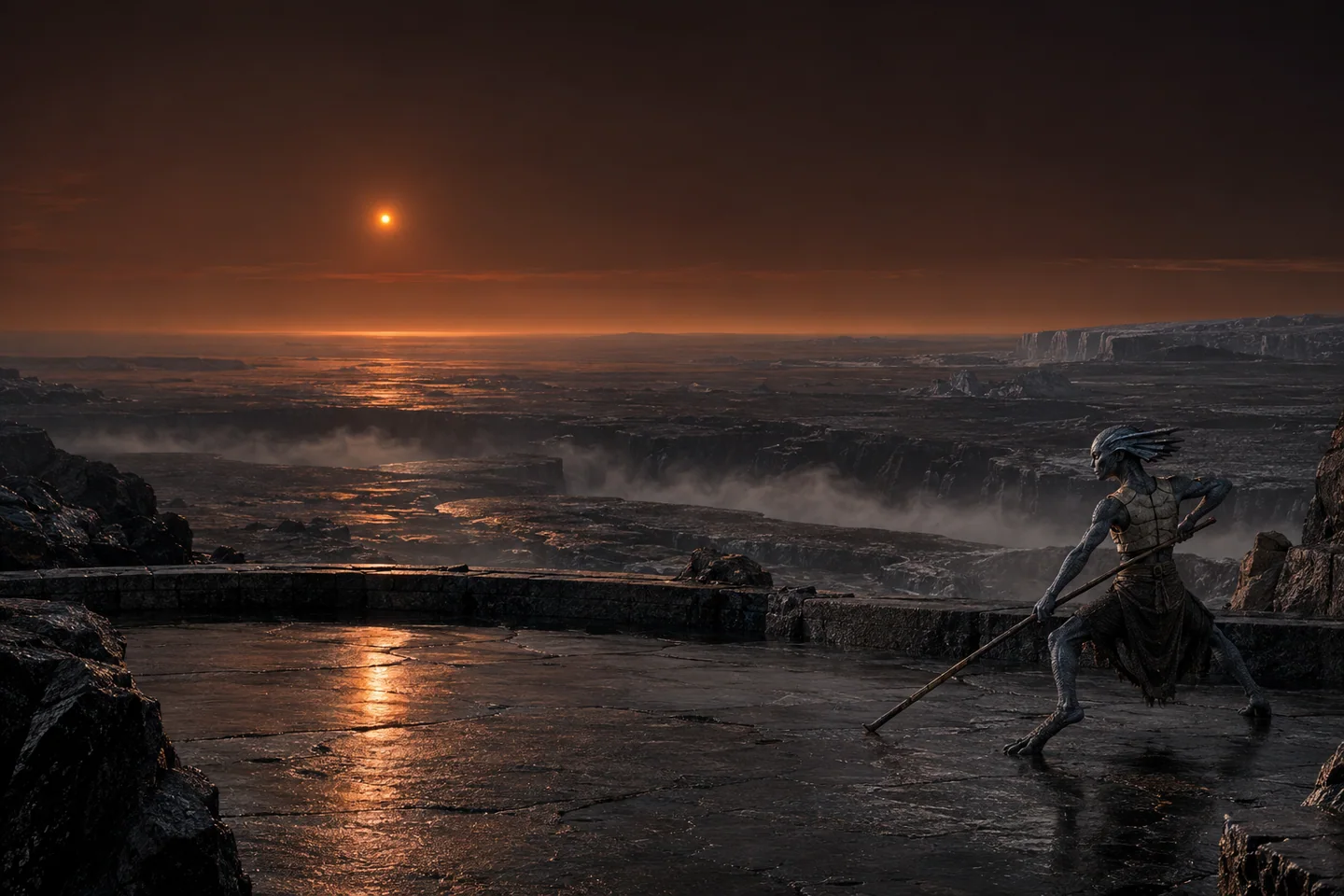
A warrior performs a slow staff form on a basalt terrace under an amber stellar horizon. Atmosphere, ice and mist are invented. Fictional warrior portrait: He lowers the staff until its tip almost meets the stone. The movement is slow enough to expose every error. Under the amber star, he repeats the form without an audience, learning where effort is useful and where it becomes tension. The long horizon offers no praise, only space in which to begin again. A faint tremor travels along the shaft. He has gripped too tightly again. He eases one hand, shifts his weight, and lets the point settle. The correction would be invisible to someone watching from the far steps, but he feels its consequences through his shoulders and down into the stone. Precision grows from these small recognitions, where the body finally tells the truth about what it is doing. There was a time when he hurried through familiar movements, treating repetition as a toll paid on the way to achievement. An older companion asked him to perform a single motion so slowly that he could name every change in balance. He found the exercise unexpectedly difficult. Since then, the simplest form has remained unfinished in the best sense: it always contains something he has not yet learned to feel. The star at the horizon offers a point around which to organize the composition of his practice. Its apparent stillness belongs to this imagined moment; his attention need not depend on the sky remaining unchanged. He studies the relationship between his own moving body and the distances beyond it. Near and far occupy the same field of vision, and he learns to attend to both without confusing their scales. Eventually fatigue will make the movement less exact. He will stop, care for the equipment, and return another day. Rest belongs to the discipline because a tired body can rehearse an error as faithfully as a useful habit. He leaves the terrace with no witness to certify his progress, carrying only a more honest knowledge of his limits. He finds a connection to the cosmos through proportion. His lifetime is brief beside the age of a star, yet this small act can still be exact. His warrior mindset is the willingness to give an ordinary repetition his full care, even when no victory is promised.
The imagined scene
The host system is real. All alien organisms, robots, societies and social histories are fictional. Moons, rings, terrain and weather are artistic assumptions unless specifically supported by a cited source. These images are not calibrated simulations of the sky.
The scientific anchor
TRAPPIST-1 e is a real catalogued exoplanet orbiting TRAPPIST-1. The local NASA composite snapshot lists an orbital period of 6.101013 days; the companion measurement table preserves reported uncertainties, limits and source provenance. The viewpoint is: speculative planetary surface. All warriors, cultures, training practices and constructed environments are fictional.
Agol et al. 2021 · NASA Exoplanet Archive system overview · Gillon et al. 2017 · Grimm et al. 2018 · Ducrot et al. 2020
Available measurements
Host: TRAPPIST-1 · 1 catalog star(s) · Rocky-size candidate
NASA composite catalog values may combine different papers. Errors and upper/lower limits are retained. “Calculated Value” means derived or estimated. Msini is a minimum mass. Missing values are unknown. A multiple-star system’s single stellar row does not describe every component. Equilibrium temperature is not a measured surface temperature.
| Quantity | Value & uncertainty | Unit | Paper / source |
|---|---|---|---|
| Planet radius | 0.92 [+0.013 / -0.012] | Earth radii | Agol et al. 2021 |
| Planet mass | 0.692 [+0.022 / -0.022] | Earth masses | Agol et al. 2021 |
| Bulk density | 4.9016 [+0.16541 / -0.18195] | g/cm³ | Agol et al. 2021 |
| Orbital period | 6.101 [+3.5e-05 / -3.5e-05] | days | Agol et al. 2021 |
| Orbital semimajor axis | 0.02925 [+0.0025 / -0.0025] | AU | Agol et al. 2021 |
| Orbital eccentricity | 0.0051 [+0.00058 / -0.00058] | Grimm et al. 2018 | |
| Orbital inclination | 89.793 [+0.048 / -0.048] | degrees | Agol et al. 2021 |
| Irradiation | 0.646 [+0.025 / -0.025] | Earth flux | Agol et al. 2021 |
| Equilibrium temperature | 249.7 [+2.4 / -2.4] | K; not surface temperature | Ducrot et al. 2020 |
| Catalog stellar effective temperature | 2,566 [+26 / -26] | K | Agol et al. 2021 |
| Catalog stellar radius | 0.1192 [+0.0013 / -0.0013] | Solar radii | Agol et al. 2021 |
| Catalog stellar mass | 0.0898 [+0.0023 / -0.0023] | Solar masses | Agol et al. 2021 |
| Catalog stellar luminosity | -3.2573 [+0.01467 / -0.01518] | log10 Solar luminosity | Agol et al. 2021 |
| Catalog stellar age | 7.6 [+2.2 / -2.2] | Gyr | Piaulet-Ghorayeb et al. 2025 |
| Catalog stellar metallicity | 0.052 [+0.073 / -0.073] | dex | Piaulet-Ghorayeb et al. 2025 |
| System distance | 12.43 [+0.018707 / -0.018707] | pc | Gaia DR2 |
What about life?
Passes a deliberately broad 0.25–1.75 Earth-flux triage window. This is not a calculated habitable zone or evidence of water or life. Atmosphere, surface pressure, water inventory, stellar activity and orbital history remain unassessed. No confirmed life; no planet-specific biosignature literature review in this release.
Papers and references
Agol et al. 2021 · NASA Exoplanet Archive system overview · Gillon et al. 2017 · Grimm et al. 2018 · Ducrot et al. 2020 · Piaulet-Ghorayeb et al. 2025 · Gaia DR2